You turn the key and get nothing but a click. A flat battery is a familiar winter problem: frost reduces capacity, short city trips never let the battery recharge, and sidelights left on finish it off overnight.
There are two ways out: charge the battery with a charger or jump-start the engine from another car. Both are simple if you follow the connection order and basic safety rules.
What you will need
- 12 V battery charger or jump leads with clamps
- a second car or a jump starter (for the jump-start option)
- safety glasses and gloves
- spanner for the terminals
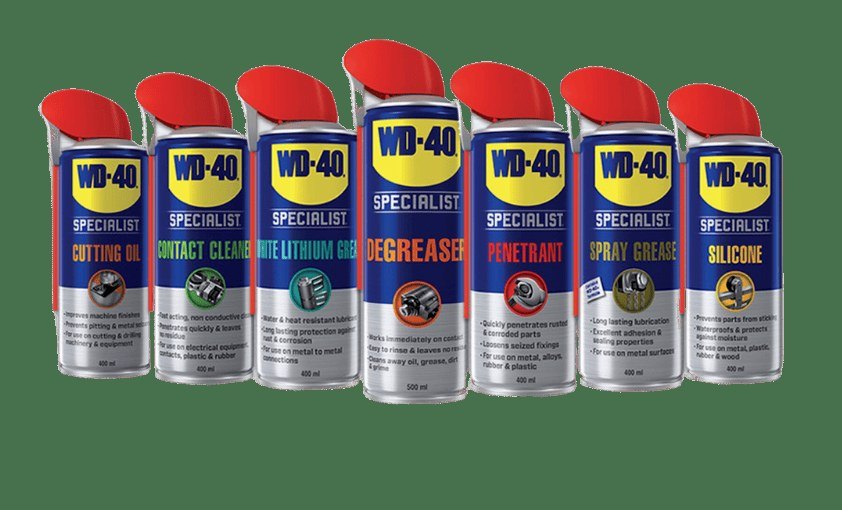
- WD-40 Specialist Contact Cleaner to clean the terminals
- WD-40 Multi-Use for seized bolts and moisture protection
- clean microfibre cloth
Important: Charge in a well-ventilated area: a battery gives off explosive gas while charging. Do not smoke nearby, never lay tools across the terminals and never connect positive to negative.
Step 1
Prepare the car and the area
Park on level ground with good ventilation.
Switch off the ignition, lights, heater and all other loads. Let the engine cool if it has just been running.
Step 2
Locate and inspect the battery
Open the bonnet. The battery is a rectangular box with two terminals: red positive and black negative. On some cars it sits under a seat or in the boot, so check the owner's manual.
If the battery is held by a clamp with seized bolts, apply WD-40 Multi-Use: it penetrates rust and deposits so the bolts undo more easily. Never charge a battery with a cracked or leaking case.
Step 3
Clean the terminals
White or greenish deposits on the terminals block current and charging. Brush them off.
Spray WD-40 Specialist Contact Cleaner onto the terminals and clamps: it removes dust, dirt and condensation and evaporates quickly. Wait until it is completely dry before attaching any clamps.
Step 4
Option 1: use a battery charger
Read the charger instructions and set it to 12 V. Attach the red clamp to positive and the black clamp to negative, and only then plug the charger in and switch it on.
Charging time depends on how flat the battery is and the charging current, so follow the charger's indicator. When finished, unplug the charger first, then remove the black clamp, then the red one.
Step 5
Option 2: jump-start from another car
Park the donor car close by without the bodies touching and open both bonnets. Connect the two positive terminals with the red lead. Attach the black lead to the donor battery's negative, and the other end to the flat battery's negative or to a bare metal point on the engine.
Start the donor car and let it run for 5 minutes. Then start your car. Once running, leave both engines on for 5-10 minutes, switch off the donor and remove the leads in reverse order.
Step 6
Check the result
Start the engine and let it run, or better still drive for 20-30 minutes without stopping so the alternator can top up the charge.
If the battery goes flat again within a day or two, it is worn out or something is draining it. Have the battery and electrics checked at a garage.
Tip: After charging, treat the terminals with a thin layer of
WD-40 Multi-Use using the
Smart Straw: the film displaces moisture and slows corrosion, which matters most in damp weather and when roads are salted.
What next
In autumn check the charge and the cleanliness of the terminals, and in winter, if you only make short trips, top the battery up with a charger once a month. Keep Contact Cleaner to hand and the click-instead-of-start problem will become much rarer.
These uses come from the experience of WD-40 users in many countries. Always follow the instructions and warnings on the product label.
More guides in «How to use».