A garage or workshop lift handles tonnes every day and lives in harsh conditions: dust, oil spray, and in winter water and salt dripping from car underbodies. Dirt and corrosion on the columns, carriages and rollers make the movement uneven, cause jerky operation and speed up wear.
Regular cleaning, protection and lubrication of moving parts do not require a service call and take little time. Below is a basic routine that complements, rather than replaces, the manufacturer's maintenance schedule.
What you will need
Important: Before maintenance, lower the lift fully, isolate the power and lock out the switch. Never work under raised arms or a platform without the mechanical safety locks engaged. Lubricate cables, chains and hydraulic parts only with the products the manufacturer specifies.
Step 1
Switch off and prepare the lift
Lower the carriages to the bottom, disconnect the power and clear tools and vehicles from the working area. This keeps you safe and gives the products time to work without the mechanism moving.
Inspect the columns, arms and platforms for hydraulic fluid leaks, cracks, stretched cables and damaged rubber pads.
Step 2
Clean the metal parts
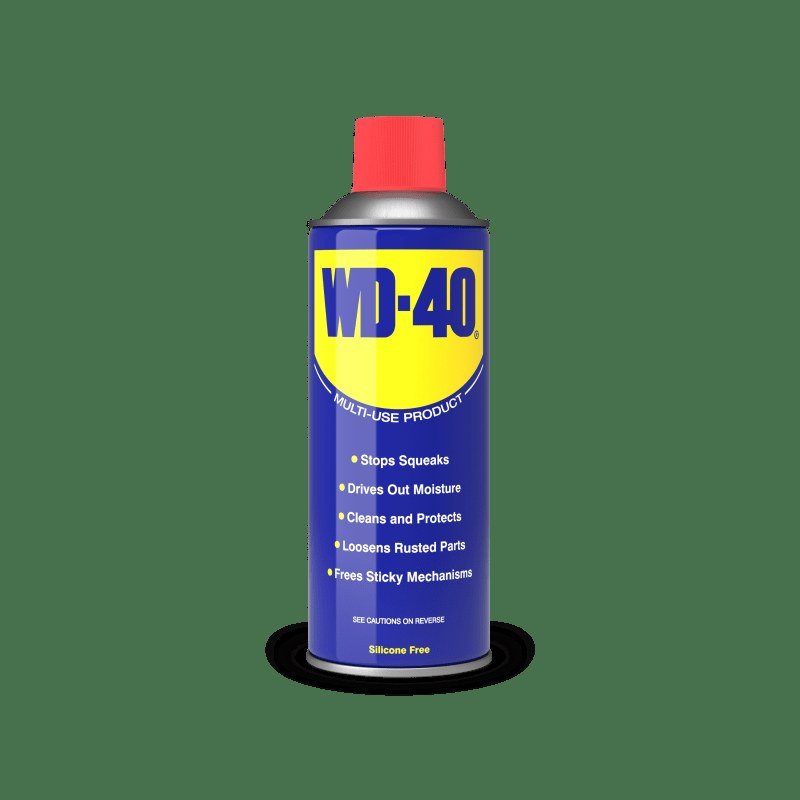
Spray WD-40 Multi-Use onto the metal surfaces of the columns, carriages, arms and screw pads. It loosens dirt and old grease and drives moisture out of gaps. In a busy workshop, WD-40 5 l with a sprayer is more convenient.
Leave it for a few minutes, then wipe with microfibre. The metal stays clean and covered with a thin protective film against rust.
Step 3
Free seized joints
Anchor bolts, arm pins and screw pads seized by salt and moisture should be treated with WD-40 Specialist Penetrant. Wait 5-10 minutes, then check fasteners for tightness with a spanner.
Swing arm pivots must move freely without sticking, as this affects accurate positioning under the vehicle's lifting points.
Step 4
Lubricate carriages and rollers
Treat column guide surfaces, carriage slide blocks, roller axles and lock pivots with WD-40 Specialist White Lithium Grease. It holds under load, does not run off vertical surfaces and resists washing out by water.
Raise and lower the lift unloaded a few times to spread the grease, then wipe off the excess.
Step 5
Check the safety locks and electrics
Make sure the mechanical safety locks click positively at every level and return under spring pressure. If a latch moves stiffly, a drop of WD-40 Multi-Use on the pivot restores free movement.
Control panel terminals, limit switches and connectors oxidise in a damp garage. Treat them with WD-40 Specialist Contact Cleaner with the power off.
Tip: In winter, salty water drips from cars onto the lift. Clear puddles under the columns and wipe the lower columns and arms weekly: that is where rust appears first.
What next
Clean and protect monthly and lubricate the carriages according to the manufacturer's schedule, or more often in a damp building. Have statutory inspections carried out by a qualified specialist at the required intervals.
These uses come from the experience of WD-40 users in many countries. Always follow the instructions and warnings on the product label.
More guides in «How to use».